Enhancing Underground Storage Tank Inspections with TankIQ
WHITEPAPER
Traditional underground storage tank inspections pose significant challenges—limited visibility, inconsistent data collection, and safety risks. The use of 3D scanning technology enables accurate, non-invasive scans. This allows for safer, faster, and more thorough data capture enabling customers to identify structural defects and irregularities that traditional methods may miss—all without requiring personnel to physically enter the tank.
Less Interruption
Underground storage tanks are critical components in fuel infrastructure, but inspecting them presents logistical, environmental, and safety concerns. Historically, inspection procedures have relied on manual entry, which introduces risk and often leads to incomplete or subjective results.
Improved Accuracy
3D Scanning technology measures tank interiors with sub-centimeter precision to deliver consistent, quantifiable data across the entire internal surface. This reduces subjectivity in assessing asset health.
It All Starts with Quality Tank Preparation
Data capture during ongoing store operations typically involves multiple parties—store maintenance, fuel transport, contractors, and vac truck services. These efforts prepare the tank for data capture by:
- Removing fuel – Conducted by the store’s fuel transport provider to minimize residual volume.
- Cleaning and rinsing interior walls – Carried out by a fuel contractor and vac truck to remove debris and residue.
- Degassing to reduce Lower Explosive Limit (LEL) levels – Air compressors and venturis eliminate vapors. LEL levels are monitored using advanced gas detection tools. Scanning begins once levels drop below 10.
Coordination with on-site personnel throughout these steps ensures readiness and data integrity.
Reducing Human Error
Once the tank is cleared of liquid and vapors, inspection can begin. Conventional inspections still rely on visual assessment or manned entry. These methods are limited by:
- Human error
- Inaccessibility of certain areas
- Elevated exposure to hazardous environments
Utilizing 3D scanning technology we are able to capture a highly detailed point cloud of the tank’s interior geometry by collecting millions of data points enabling digital twin generation of the tank.
Detection of Unseen Defects
Measurements taken at the center of the tank can miss geometric anomalies. Scans reveal structural anomalies, corrosion patterns, and deformation that are often missed by visual inspection. Collections from these scan measurements over time allow for historical comparisons to detect degradation.
Enhanced Safety
Personnel entering the tank is an unnecessary risk. The use of 3D scanning technology eliminates the need for manned entry, removing personnel from confined spaces, and lowers risk of exposure to toxic vapors or physical hazards. 3D scanning is performed from above-ground ports using equipment operated externally.
Results
Collect Data Faster
See Insights Clearer
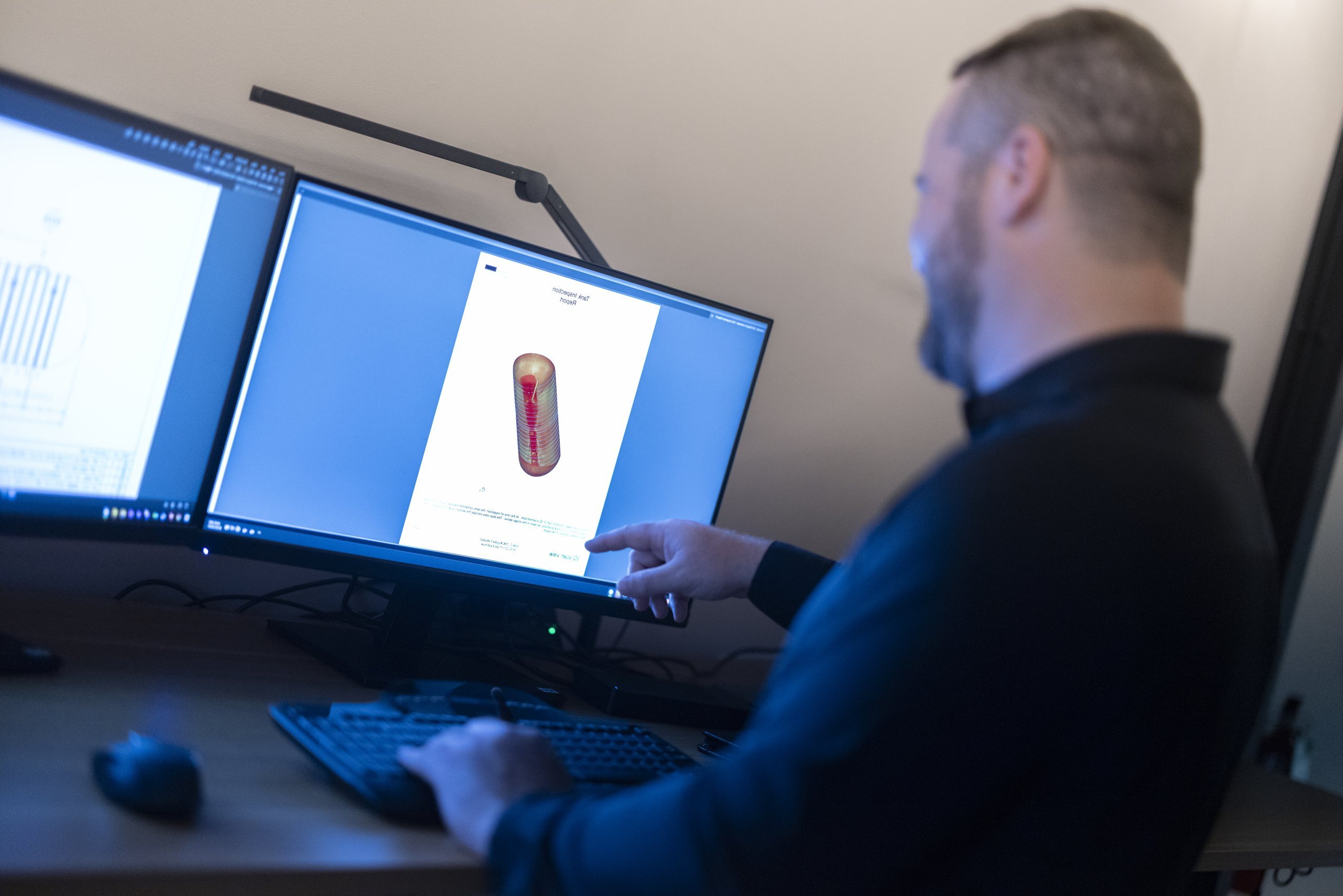
Once on-site personnel verify tank prep is complete, they utilize a 3D scanner to capture point cloud data in a matter of minutes, data is processed off site to generate TankIQ Results which includes:
3D Scan View(s)
A high-resolution point cloud image of the tank’s lower half, providing a visual representation of its current state.
Interactive 3D Color Map
A color-coded 3D model that highlights areas of significant deviation from the best fit cylinder. Allowing for quick identification of potential problem areas.
Roundness Sections
Precise section cuts along the tank’s centerline, complete with detailed deviation measurements from the best fit cylinder. These sections offer a visual representation of the tank’s deviation measurements and any deformations present.
Customers benefit from shorter downtime, fewer safety concerns, and actionable data for smarter lifecycle planning.